
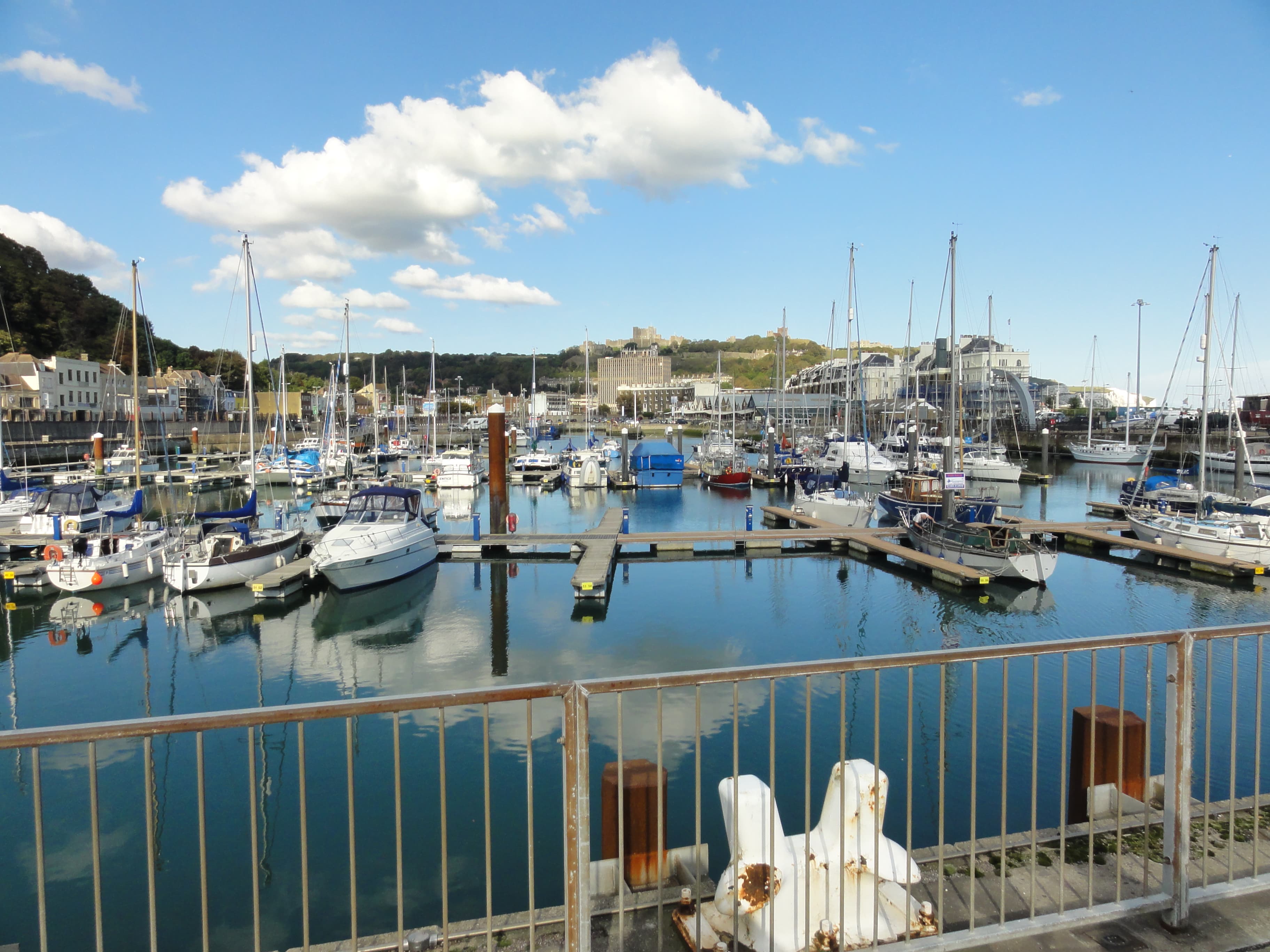
Dover
Brief
Dover is entered by the Western or the Eastern Entrance, from the Dover Strait, where a Traffic Separation Scheme carries over 400 commercial vessels a day. Inside the breakwaters the ferry berths lie at the Eastern Docks, and the Western Docks hold the three cruise berths, the Outer Marina and, through a lock, Wellington Dock. Every movement within a mile of the port and inside the harbour is controlled by Dover VTS.
Approach
Dover VTS monitors VHF 74. A yacht calls when two miles off, giving her name, position, destination, dimensions and any defects, and calls again about 200 metres off either entrance for permission to enter, which is not usually given before then. Three red lights at the entrances mean do not proceed without specific permission, and the traffic signals are obeyed without exception.
Leisure craft pass through only where they will not impede ferries or commercial traffic. A yacht crossing the harbour from east to west keeps well south, close to the Southern Breakwater and clear of the ferry and cruise berths. The Outer Marina entrance runs inbound and outbound convoys, with no two-way traffic, and inside it the marina answers on VHF 80. Entry under sail alone is not attempted, and in south-westerly gales a steep, confused swell can build off the Western Entrance.
The speed limit is 8 knots in the Outer and Inner Harbours and 4 knots in the marina. In the Strait, Channel VTS, run from Dover Coastguard and CROSS Gris-Nez, broadcasts on VHF 11 every hour, or every half hour in poor visibility, and vessels of 300 gross tonnes and over report under the CALDOVREP scheme.
Pilotage
Pilotage is compulsory within the harbour and for one mile beyond its seaward limits for vessels over 50 metres, and for vessels over 20 metres certified for more than 12 passengers, carrying dangerous goods in bulk or hampered. Holders of a Pilotage Exemption Certificate are exempt, and a pilot is strongly recommended for anyone unfamiliar with the port.
The pilot is booked through Dover VTS on VHF 74 at least two hours before reaching the pilot station inbound, and an hour before departure outbound. The pilot boards 3 miles due east of the Eastern Entrance, at 51°07.28'N 001°25.29'E, and a vessel does not close within 3 miles without VTS permission until the pilot is on the bridge.
- Each act of pilotage
- 321.20
- Boarding or landing
- 623.80
- Each hour on board beyond two
- 229.20
Tides
- Reference
- Dover, standard port
- MHWS
- 6.7m
- MHWN
- 5.3m
- MLWN
- 2.2m
- MLWS
- 0.8m
- HAT
- 7.3m
- Low water, Fri 25 Sept, 18:16 1.2m
- High water, Fri 25 Sept, 23:18 6.4m
- Low water, Sat 26 Sept, 06:35 1.3m
- High water, Sat 26 Sept, 11:33 6.6m
- Low water, Sat 26 Sept, 18:57 1.1m
- High water, Sat 26 Sept, 23:51 6.6m
Admiralty predictions, UK time, refreshed hourly. Planning information, not for navigation.
Weather
Dover lies in shipping forecast sea area Dover, issued at 2300, 0500, 1100 and 1700 UTC, and in the inshore waters area from North Foreland to Selsey Bill. Dover Coastguard broadcasts maritime safety information on VHF 62, 63 or 64 after an announcement on VHF 16, with the main broadcasts at 07:10 and 19:10 local time, and NAVTEX from Niton covers the Strait.
Visibility in the Strait is often poor. The port closes when the wind in the harbour is sustained above 55 knots from between south-south-west and west-south-west, no vessel moves when it is sustained above 40 knots, and movements are restricted when visibility falls below 500 metres.
Berths
- Outer Marina
- Port of Dover
- 30m
- 3.5m
- 250 berths, all states of tide. Visitors berth here without booking; vessels over 50 GT call the office first. 16 amp, 32 amp on the larger berths. VHF 80
- Wellington Dock
- Port of Dover
- 24m
- 2.7m
- 135 berths through the lock. 50 tonne hoist. The marina gives the gate as about 1.5 hours either side of high water and also states lock access at any hour; confirmed on booking
- Cruise Terminal 1
- Port of Dover
- 250m
- 8.5m
- Cruise berth. Water, waste and sewage
- Cruise Terminal 2
- Port of Dover
- 350m
- 8.5m
- Cruise berth. Water, waste and sewage
- Berth 4
- Port of Dover
- 320m
- 10m
- East side of the Prince of Wales Pier. Not used by vessels under 125m above Force 7
Alongside
The fuel berth in the Tidal Harbour, run by George Hammond, has red and white diesel and petrol on a 50 metre pontoon. It is open 06:00 to 18:00 from May to September, and 06:30 to 10:30 and 15:30 to 17:30 from October to April.
The marina has 16 amp power on every berth and 32 amp on the larger berths, with laundry, showers and a 50 tonne hoist in Wellington Dock. It is cashless, and non-UK food waste is arranged with the office. A yacht arriving from outside the United Kingdom flies the Q flag until Border Force has cleared her.
Ashore
Dover Priory has high-speed trains to London St Pancras in about an hour and five minutes, and the port gives Heathrow as 95 minutes and Gatwick as 78 minutes by road. LeShuttle runs from Folkestone to Calais in 35 minutes.
Buckland Hospital in Dover has an urgent treatment centre open 08:00 to 20:00, and the nearest emergency departments are at the William Harvey Hospital in Ashford and the Queen Elizabeth the Queen Mother Hospital in Margate.
Questions
- Is pilotage compulsory for a superyacht at Dover?
- Pilotage at Dover is compulsory for vessels over 50 metres, and for vessels over 20 metres certified for more than 12 passengers. The pilot is booked through Dover VTS on VHF 74 at least two hours before reaching the pilot station, 3 miles east of the Eastern Entrance.
- How does a yacht enter Dover harbour?
- A yacht calls Dover VTS on VHF 74 when two miles off, and again about 200 metres off either entrance for permission to enter. The traffic signals at both entrances are obeyed without exception, and the marina answers on VHF 80.
- What size of yacht can berth in Dover Marina?
- The Outer Marina takes yachts of up to 30 metres and 3.5 metres draught at any state of tide, and Wellington Dock, through its lock, yachts of up to 24 metres. A berth for a larger yacht is agreed with the Port of Dover before arrival.
- How far is Dover from London?
- High-speed trains run from Dover Priory to London St Pancras in about an hour and five minutes, and Heathrow is about 95 minutes by road.
Charges are revised each year. This page is a guide, not a quotation.
Port of Dover: key facts, port control and VTS, arriving and departing procedures, berths and services, operating safety limitations, General Directions 2025, Pilotage Direction No. 8 and pilotage tariff 2026, cruise trade; GOV.UK, Dover Strait crossings and MGN 364 Amendment 2; National Oceanography Centre, Dover tide gauge; Met Office shipping and inshore waters forecasts; Maritime and Coastguard Agency, maritime safety information broadcasts; George Hammond fuel berth; Southeastern; East Kent Hospitals. Checked 25 September 2026.
- Dover VTS
- Dover Marina, arriving
- Dover Marina, berths and services
- Port of Dover, operating limits
- Port of Dover, Pilotage Direction No. 8
- Dover Strait and Channel VTS, GOV.UK
- Dover tidal levels, NTSLF
- Met Office shipping forecast
- Met Office inshore waters forecast
- George Hammond fuel berth
- Southeastern, London to Dover
- Clearance for a private or commercial yacht
- The pleasure craft report